
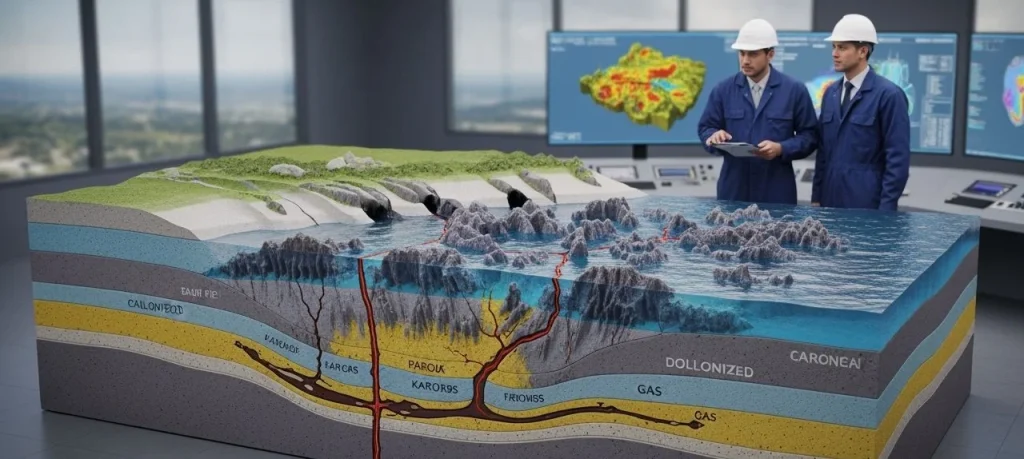
Carbonate reservoirs account for a significant portion of Indonesia’s hydrocarbon resources. Unlike clastic systems, carbonate reservoir quality is strongly controlled by facies variability, reef architecture, diagenesis, dolomitization, karstification, and fracturing.
Theme: Isolated Platform & Reef Build-Up Architecture
Key formations:
These Miocene carbonates represent reefal build-ups and shallow marine platform systems.
Learning Focus:
Theme: Present-Day Reef & Platform System as Subsurface Analog
The modern reef complexes north of Jakarta provide a direct analog for Miocene–Recent carbonate platforms.
Learning Focus:
Linking modern processes to ancient reservoirs
Theme: Isolated Carbonate Platforms and Deepwater Margin Systems
Carbonate units equivalent to pre-Ngimbang Formation intervals are exposed in uplifted tectonic settings.
Learning Focus:
Theme: Karstified Platform Carbonates & Diagenetic Overprint
This classic outcrop belt exposes thick Miocene platform carbonates with intense karstification.
Learning Focus:
Impact of uplift on reservoir quality
Theme: Tectonically Enhanced Carbonate Reservoir Systems
The Banggai region exposes fractured Mesozoic–Pre-Tertiary carbonates associated with thrusting and uplift.
Learning Focus:
Exploration risk in fractured carbonate plays
Theme: Tropical Isolated Carbonate Platforms & Reef Complexes
Spectacular uplifted reef systems provide analogs for Miocene isolated carbonate build-ups across Eastern Indonesia.
Learning Focus:
Participants will develop practical understanding of:

Carbonate reservoirs are inherently heterogeneous and diagenetically complex. Understanding:
is essential to reduce uncertainty in volumetrics, well placement, and recovery strategy.