

We prepare comprehensive POD studies integrating static and dynamic reservoir models, production forecasting, well placement strategy, facility planning inputs, and economic evaluation. The objective is to ensure technically robust, regulator-ready development plans aligned with reserve estimates and long-term production targets.
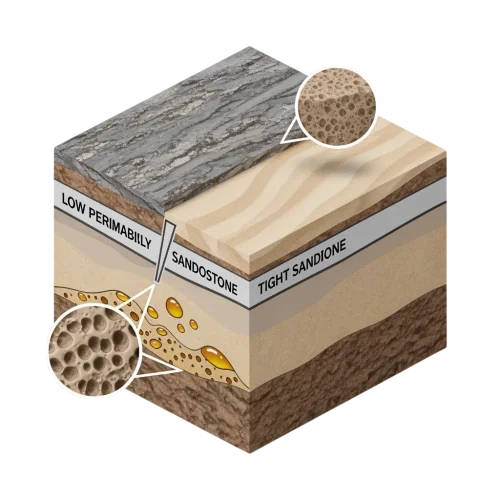
This study focuses on tight, heterogeneous, or low-resistivity reservoirs with suboptimal performance. We evaluate rock quality, diagenesis, fracture contribution, stimulation potential, and development strategy to unlock remaining hydrocarbons from marginal intervals.
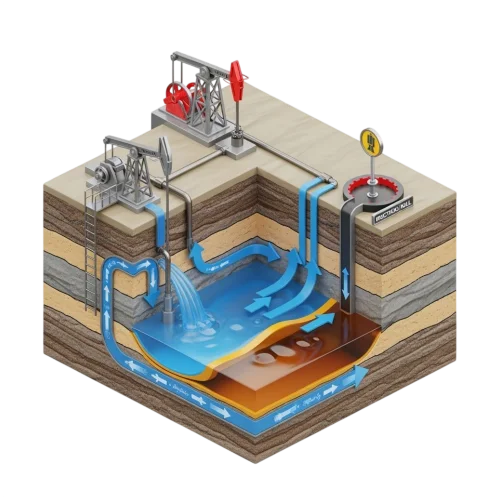
We design and optimize waterflood programs through reservoir characterization, injectivity analysis, pattern design, voidage replacement assessment, and breakthrough prediction. The goal is to improve sweep efficiency and stabilize reservoir pressure for sustained production.

We evaluate and design EOR strategies including chemical, gas injection, or thermal methods based on reservoir screening, fluid properties, rock-fluid interaction, and simulation forecasting. The study defines technical feasibility, incremental recovery, and economic viability.
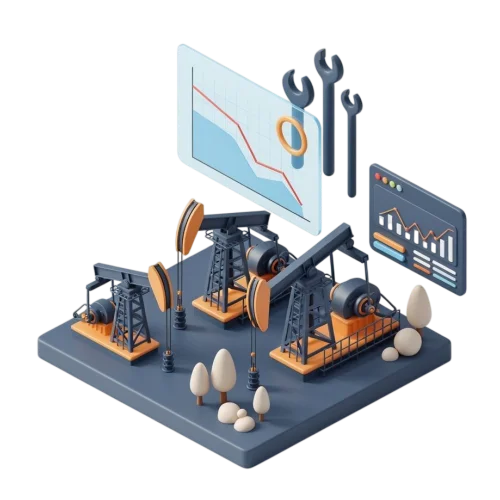
This service reassesses producing assets to identify bypassed pay, infill drilling targets, recompletion opportunities, and cost-effective redevelopment strategies. The focus is maximizing recovery while maintaining economic efficiency in late-life assets.
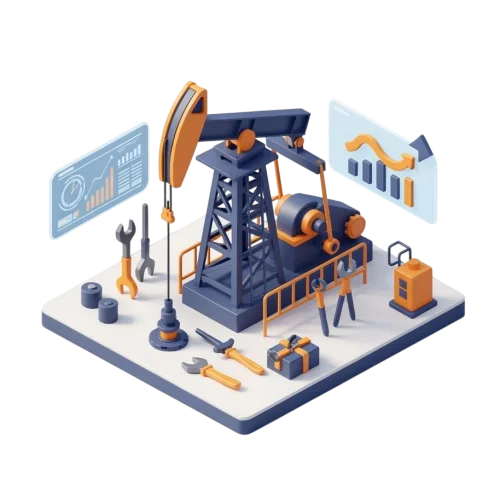
We evaluate underperforming or shut-in wells using integrated subsurface review, production diagnostics, and reservoir modeling. The objective is to identify reactivation potential, artificial lift optimization, and low-cost production enhancement opportunities.

We assess technical feasibility of carbon storage within depleted reservoirs or saline aquifers, including injectivity, seal integrity, fault stability, storage capacity, and long-term containment risk. This study supports energy transition strategies and emission reduction initiatives.

Independent QC of static models ensures geological consistency, proper facies distribution, petrophysical integrity, and realistic volumetric estimation. We validate modeling assumptions and workflow to ensure reliable reservoir representation.
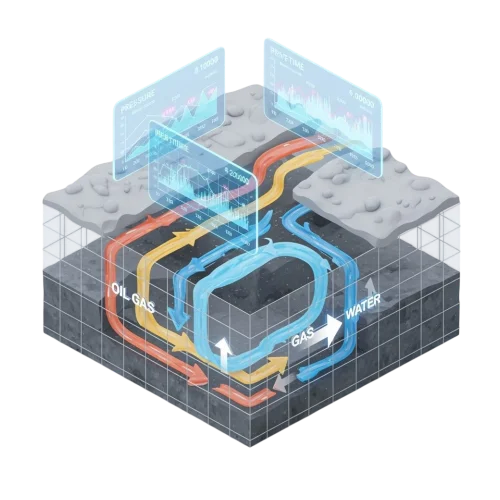
We review simulation models for history match quality, boundary conditions, fluid behavior, and forecast reliability. The objective is to ensure that development decisions and investment planning are based on technically sound predictive models.